


AI is Forcing Software Engineering to Adopt Formal Traceability
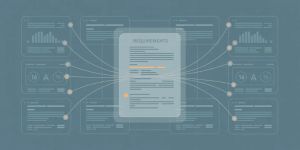
For decades full artifact traceability — requirements, stories, test cases, models, code — etc, has been difficult to accomplish in software engineering.
Everyone agrees it’s important — especially in regulated, safety-critical, or long-lived systems — but few teams truly “enjoy” implementing it. Traceability is often seen as overhead: something added late, maintained reluctantly, and justified primarily by audits or compliance.
AI may change that dynamic.
Not because regulators suddenly care more — but because AI systems make engineering decisions harder to explain, harder to reproduce, and harder to trust without structure.
The Old Tradeoff: Speed vs Traceability
Traditional software engineering has long relied on an implicit tradeoff:
- Move fast, accept ambiguity
- Add traceability later if required
- Rely on human understanding to fill in the gaps
This model worked reasonably well when:
- code changes were authored by humans
- system behavior was mostly deterministic
- intent could be inferred from commit history, tickets, or tribal knowledge
Even then, it broke down at scale — but teams managed.
AI may remove that safety net.
AI Systems Break Informal Engineering Assumptions
AI-assisted development introduces several new realities:
- Code is partially machine-generated
- Design intent may exist only in prompts or training data
- Behavior can shift without explicit code changes
- Failures are often probabilistic, not deterministic
In this environment, questions like these become unavoidable:
- Why does the system behave this way?
- What requirement does this behavior satisfy?
- Which decision — human or machine — led to this outcome?
- Can we prove that this system still meets its original intent?
Without formal traceability, those questions don’t have reliable answers.
Why AI Makes Traceability a First-Order Concern
1. AI Blurs the Line Between Design and Implementation
When a model generates code, configurations, or test cases, design decisions are no longer fully explicit.
Traceability becomes the only reliable way to connect:
- original requirements
- prompts or constraints
- generated artifacts
- observed behavior
Without those links, teams are left with working systems they can’t confidently explain.
2. Debugging AI Systems Requires Context, Not Just Logs
Traditional debugging asks:
What line of code caused this?
AI debugging asks:
Which assumption, input, or training influence caused this behavior?
That requires traceability across:
- requirements
- datasets
- model versions
- deployment configurations
- runtime observations
This isn’t bureaucracy — it’s the minimum structure needed to reason about complex systems.
3. Compliance Will Follow Capability, Not the Other Way Around
Historically, traceability was driven by regulation.
With AI, it will be driven by operational necessity first, regulation second.
Teams that can’t explain:
- how decisions were made
- why outputs changed
- whether requirements are still satisfied
will struggle long before auditors show up.
Informal Traceability Won’t Scale in an AI World
Many teams rely today on:
- commit messages
- tickets
- wiki pages
- “we know how this works”
AI systems don’t respect those boundaries.
As systems become more autonomous and adaptive, traceability must be explicit, structured, and continuously maintained, or it may collapse under its own ambiguity.
This is especially true in:
- embedded systems
- regulated industries
- long-lived products
- systems that mix hardware, software, and AI
In other words: the environments that already understood the value of traceability were just early.
What “Good” Traceability Looks Like Going Forward
AI doesn’t require more documentation.
It requires better connections.
Effective traceability in AI-enabled engineering:
- links intent to implementation continuously
- treats requirements as living artifacts
- spans development, deployment, and operation
- supports explanation, not just compliance
When done well, traceability stops being a tax and becomes an engineering asset.
The Inevitable Shift
AI doesn’t eliminate the need for formal engineering discipline — it exposes where that discipline was already weak.
Teams that resist traceability will find themselves unable to:
- explain failures
- certify behavior
- evolve systems safely
- scale AI successfully
Teams that embrace it will move faster with confidence.
AI is making traceability unavoidable.
A Note for Teams Navigating This Shift
If your organization is wrestling with how AI, modern DevOps practices, and formal engineering discipline intersect, these are exactly the kinds of conversations we explore at 321Gang — helping teams connect requirements, tooling, and real-world engineering workflows without turning process into overhead.
And if you’d like to continue the discussion sparked by this article or share how your team is approaching AI and traceability, feel free to reach out directly to us at info@321gang.com.

321Gang | 14362 North FLW | Suite 1000 | Scottsdale, AZ 85260 | 877.820.0888