


What PLM Can’t Do (And Why You Still Need ALM/ELM)
For years, engineering leaders have searched for the mythical “one tool that does everything.”
PLM vendors often promise exactly that: a single platform to manage mechanical design, electronics, software, requirements, testing, and change.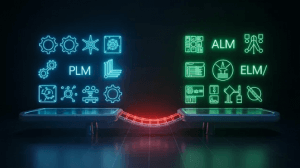
For more background on ALM/ELM/PLM visit — PLM, ALM and ELM — The battle of three letter acronyms.
But here’s the truth every modern engineering organization eventually discovers:
PLM cannot replace ALM or ELM. And it shouldn’t.
Mechanical and software engineering operate under fundamentally different rules.
Trying to force one tool to manage both creates friction, slows teams down, and makes traceability harder — not easier.
Here’s why PLM isn’t enough, and how ALM/ELM fills the gap.
1. PLM Was Never Designed for Software Engineering
Product Lifecycle Management (PLM) systems were built around:
- CAD
- Bill of Materials (BOMs)
- Hardware change control
- Supplier and manufacturing workflows
These are structured, physical, slow-changing artifacts.
Software is the opposite:
- Highly iterative
- Rapidly changing
- Non-physical
- Driven by requirements, tests, versioning, and integration behavior
PLM fundamentally cannot model software behavior.
2. Why Forcing Software into PLM Creates Problems
Problem 1 — Missing lifecycle concepts
PLM doesn’t natively handle:
- Stories
- Requirements versions
- Test results
- Pipelines
- Branching strategies
- Code reviews
These must be hacked in or bolted on — and it never scales.
Problem 2 — Traceability breaks
PLM can store a requirement.
It cannot naturally trace it across:
- Architecture
- Variants
- Source code
- Builds
- Tests
- Defects
Which is why teams constantly revert to spreadsheets.
Problem 3 — It slows down agile development
Software teams need:
- Continuous Integration
- Rapid branching and associated merging
- Frequent releases
- Automated testing
- Pipeline-based validation
PLM workflows are too rigid for agile software delivery.
3. ALM/ELM Completes What PLM Cannot Do
Application Lifecycle Management (ALM) and IBM Engineering Lifecycle Management (ELM) systems are built for software-driven products.
They support:
- Requirements management
- Modeling / MBSE
- Test management
- Real-time traceability
- Workflow automation
- Variant and configuration management
- Compliance evidence
PLM excels at hardware.
IBM ELM excels at systems and software.
Together, they form the actual “digital thread.”
4. The Future Is Not PLM vs ALM/ELM — It’s Integration
The strongest engineering organizations don’t replace one system with another — they connect them.
A modern digital engineering stack looks like:
- PLM → mechanical, electrical, manufacturing
- ELM/ALM → software, systems engineering, traceability
- MBSE → shared architecture and system behavior
- DevOps / GitLab → implementation + pipelines
- Test automation → continuous verification
With integration, teams finally get:
- End-to-end traceability
- Synchronized requirements and engineering data
- Clear responsibilities across hardware/software teams
- Compliance-ready reporting
- A complete digital thread from concept → delivery
5. So Do You Still Need ALM/ELM? Absolutely.
If your product contains:
- Software
- Firmware
- Embedded logic
- Networked behavior
- AI/ML components
- Complex system interactions
…PLM alone will never be enough.
Modern products demand a modern lifecycle — and that means ALM/ELM working with PLM, not being replaced by it.
Want to learn more on integrating PLM and ALM/ELM? Contact 321Gang.

321Gang | 14362 North FLW | Suite 1000 | Scottsdale, AZ 85260 | 877.820.0888