
Mainframe SCM Modernization: From Legacy to Git
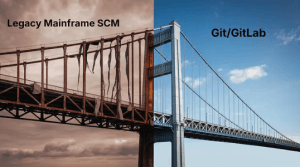
Mainframe teams have depended on Software Configuration Management (SCM) tools such as Endevor, SCLM, and ChangeMan ZMF to manage source code, govern promotions, and support mission-critical workloads. These tools were built for stability, compliance, and predictable change control — and they excelled at those goals.
But as described in the earlier article, “Why Organizations Are Moving from Endevor to Git”, a modernization trend is accelerating across industries. Organizations are not abandoning the mainframe; instead, they are aligning their mainframe development practices with the modern DevOps pipelines used across the rest of the enterprise.
This follow-on article expands on that shift, explores the broader landscape beyond Endevor, and examines why companies are moving toward Git and GitLab.
1. Why Traditional Mainframe SCM Tools No Longer Meet Modern Needs
Legacy SCM tools such as Endevor, SCLM, and ChangeMan ZMF were engineered during an era defined by monolithic releases, waterfall delivery, and tightly controlled promotion environments. These tools remain reliable and deeply entrenched, but modern development expectations differ in fundamental ways.
Today’s software delivery landscape requires distributed version control, automated testing, integrated CI/CD pipelines, API-driven workflows, and close collaboration between mainframe and distributed teams. Traditional mainframe SCM tools were not designed for these capabilities.
Challenges Commonly Reported by Enterprises
• Limited integration with contemporary DevOps tooling such as GitLab CI, Jenkins, and Azure DevOps
• High onboarding costs for developers unfamiliar with ISPF-driven SCM workflows
• Inflexible branching and parallel development capabilities
• Difficulty creating unified pipelines that span mainframe and cloud systems
• Shrinking talent pool as experienced mainframe SCM administrators retire
These gaps are not failures of the legacy tools — they reflect a changing ecosystem.
2. Cost Savings Are Now a Primary Driver of SCM Modernization
While many organizations begin modernization efforts to improve productivity or collaboration, cost savings increasingly drive decision-making. Benchmark data from IBM, Forrester, DevOps Research & Assessment (DORA), and independent mainframe modernization studies reveal substantial financial impact.
Estimated Cost Savings
Reduced onboarding time
Organizations report a 25% to 40% reduction in developer onboarding time when shifting from legacy SCM workflows to Git-based systems. Git familiarity reduces the need for specialized training.
Developer productivity gains
Feature branching, code reviews, and automated pipelines typically improve developer productivity by 20% to 50%.
Improved release frequency
Modern DevOps tooling often enables a two- to fivefold increase in release throughput. Faster releases reduce overall change cost.
Lower tooling and maintenance costs
Enterprises frequently reduce tooling costs by 20% to 40% after modernizing SCM infrastructure and eliminating legacy integration overhead.
Reduced risk and audit burden
Automation and traceability improve audit outcomes, reducing compliance overhead by 15% to 30% in regulated industries.
Fewer production defects
Automated testing and code review pipelines typically reduce defect rates by 10% to 30%.
References:
IBM State of Mainframe DevOps report, DORA Accelerate State of DevOps Reports, Forrester Total Economic Impact™ of GitLab (commissioned study)
3. Why Organizations Choose Git or GitLab
Git has become the global standard for version control, widely adopted across industries. Using Git on the mainframe allows teams to operate with the same workflow model they use for all other languages and platforms.
Enterprises cite the following benefits:
• Feature branching and merge request workflows
• Integrated CI/CD and DevSecOps pipelines
• Built-in security scanning and governance
• Developer familiarity
• Common tooling across distributed and mainframe teams
• Strong ecosystem support and integrations
GitLab in particular offers a unified DevSecOps platform where SCM, CI/CD, security scanning, and compliance features coexist, reducing tool sprawl and complexity.
4. Key Considerations When Migrating from Legacy SCMs
Modernizing from Endevor, SCLM, or ChangeMan requires careful planning. Successful organizations focus on the following areas.
Repository and branching strategy
Mapping data sets, components, and monolithic structures into Git repositories requires deliberate modeling.
Pipeline automation
Legacy compile, link-edit, and package steps must be translated into modern CI/CD pipelines using tools such as GitLab CI, Jenkins, or IBM Dependency Based Build (DBB).
Promotion and governance logic
Promotion models deeply embedded in Endevor or ChangeMan workflows must be replicated or reimagined in the new environment.
Security and compliance
GitLab offers strong governance capabilities, but they must be configured to meet Sarbanes-Oxley, PCI, HIPAA, FDA, or defense industry requirements.
Developer experience
The cultural shift from panel-driven SCM to Git workflows is often one of the most important success factors in modernization efforts.
5. Common Migration Patterns Across Industries
Enterprises typically follow one of the following modernization paths:
Endevor to Git/GitLab
The most common path, especially in financial services.
ChangeMan to GitLab
Often motivated by broader enterprise DevOps modernization.
Hybrid transition
Git handles source; legacy SCM controls promotions until automation matures.
Full replacement
Git or GitLab manages SCM, and CI/CD pipelines fully replace legacy promotion workflows.
No two migrations are identical. The technical landscape, regulatory needs, and organizational culture all shape the modernization path.
6. Why Mainframe SCM Modernization Is Not a DIY Project
It is tempting for organizations to approach mainframe SCM modernization as an internal engineering task: convert the repositories, configure the pipelines, train the developers, and migrate the workflows. In practice, however, these initiatives consistently prove to be complex, multi-layered transformations that touch nearly every part of the software delivery lifecycle.
Firms that specialize in mainframe modernization, DevOps enablement, and toolchain integration consistently highlight the same themes: organizations routinely underestimate the technical depth, cross-system dependencies, and sequencing discipline required to successfully replace Endevor, SCLM, or ChangeMan with Git or GitLab.
Several factors contribute to why this is not an ideal do-it-yourself effort.
The Technical Landscape Is Highly Interdependent
Legacy SCMs are not isolated tools; they sit at the center of a mainframe ecosystem that includes:
• promotion models
• compile and link-edit processes
• DB2, IMS, and CICS integration
• batch scheduling
• deployment automation
• regulatory audit dependencies
• exit routines and extension logic
Each dependency must be understood, mapped, and re-implemented in the new toolchain. Missing just one integration point can break downstream workflows or destabilize production systems.
Migration Requires Precise Sequencing and Change Control
Modernization involves:
• restructuring source assets
• defining new repository layouts
• determining appropriate branching strategies
• establishing automated build pipelines
• validating promotion workflows under load
• aligning test and quality gates with compliance needs
A mis-sequenced step can generate regressions, create promotion gaps, or leave the organization without a reliable rollback path. Successful migrations follow a rigorously designed sequence that accounts for technical, operational, and regulatory requirements.
Internal Teams Often Lack Cross-Platform Experience
Mainframe specialists understand COBOL, JCL, DB2, and RACF.
Distributed DevOps teams understand Git, GitLab, CI/CD, containers, and automated testing.
SCM modernization requires both.
The most common failures occur when organizations rely solely on one side of the skill set. The result is either a technically correct migration that is operationally unusable, or a modern toolchain that does not faithfully replicate critical mainframe governance and promotion rules.
Tooling Choices Have Long-Term Architectural Impact
Decisions made early in the migration — such as repository design, branching models, and CI/CD architecture — shape the next decade of development. Poorly designed structures lead to merge bottlenecks, excessive branching complexity, audit gaps, or pipeline performance issues.
The responsibility for these decisions should not fall on teams with limited prior modernization experience.
Hidden Risks Can Lead to Significant Business Disruption
Similar to what modernization specialists emphasize, the risks in a DIY approach include:
• unrecognized dependencies between legacy environments
• misaligned promotion logic that allows changes into production unintentionally
• pipeline designs that do not enforce required quality or compliance controls
• lack of rollback mechanisms
• disruption of parallel releases or emergency fixes
• unexpected outages due to improperly sequenced configuration changes
These risks carry real cost and reputational impact, particularly in regulated or customer-facing industries.
The Value of Working with an Experienced Modernization Partner
Organizations that partner with a specialist benefit from:
• experience designing migrations across multiple SCM platforms
• predefined patterns, accelerators, and reference architectures
• proven sequencing and risk-mitigation strategies
• deep familiarity with both mainframe workload constraints and modern DevOps tooling
• faster time-to-value and reduced experimentation
• confidence that promotion logic and audit requirements are preserved
• smoother cultural transition for developers and operations teams
A partner can guide the organization through planning, architecture design, workflow transformation, migration execution, and team enablement — reducing risk while ensuring the modernization effort produces measurable ROI.
A well-executed migration is not only possible — it becomes a competitive advantage. But it requires expertise, cross-platform understanding, and structured guidance that most organizations do not have internally.
Conclusion
Mainframes remain strategically important. What is changing is how development teams collaborate, review, test, automate, and deliver high-value updates. Transitioning from legacy SCM tools to Git or GitLab is no longer simply a tooling upgrade; it is a modernization strategy that reduces cost, aligns the mainframe with enterprise DevOps workflows, and improves delivery performance.
The organizations taking this step today are future-proofing both their mainframe environments and their development teams.
If you’re exploring a move to a modern SCM environment, 321Gang can help you evaluate options and build a practical roadmap. Contact us to start the conversation.
321Gang | 14362 North FLW | Suite 1000 | Scottsdale, AZ 85260 | 877.820.0888