


AI for Engineers: LLMs in Firmware and Model-Based Engineering
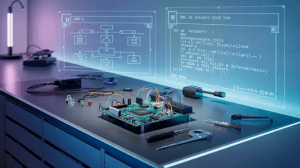
Artificial intelligence is rapidly reshaping engineering workflows — not as a replacement for human expertise, but as a powerful accelerator for tasks that once consumed large portions of development time. Two areas seeing major practical benefits are embedded/firmware development and model-based engineering (MBE).
Although these disciplines focus on different levels of abstraction, they share a common pattern:
AI assists with structure, scaffolding, exploration, and consistency — while engineers retain responsibility for correctness, constraints, and design intent.
AI for Firmware Developers: Why Claude-Style Coding Assistants Are Actually Useful
Embedded developers have long believed that AI tools “don’t understand the hardware,” and historically that was true — traditional autocomplete systems were easily confused by low-level code, real-time constraints, memory limits, or board-specific dependencies.
However, modern LLM-powered coding assistants (such as those referred to as Claude Code) behave very differently from traditional autocomplete tools.
Their strengths align surprisingly well with the needs of embedded teams:
1. Large-Context Understanding
Newer LLMs can take in extremely large windows of context. Instead of guessing from a few lines of code, they can analyze:
- Entire driver files
- Hardware abstraction layers
- Register maps
- Build configurations
- Coding standards
This allows AI to propose code that aligns with the architectural patterns already in place.
2. Fast Generation of Structured Boilerplate
Firmware often requires repetitive scaffolding:
- Peripheral initialization
- RTOS task structures
- Interrupt handlers
- State machines
- Communication protocol frames
- Test harnesses and sanity-check routines
AI excels at producing structured templates for these elements, allowing engineers to tune and refine rather than hand-craft every file from scratch.
3. Accelerated Reverse Engineering of Legacy Code
Many firmware teams inherit old codebases with:
- Sparse or outdated documentation
- Inconsistent coding styles
- Tribal knowledge that disappears with turnover
AI can summarize functions, infer intent, highlight suspicious patterns, and create test cases around undocumented modules — giving engineers a head start on understanding systems they did not build.
4. Embedded Constraints Still Require Human Judgment
AI suggestions must be reviewed carefully to ensure:
- Timing requirements are met
- Stack and memory budgets are not exceeded
- Interrupt latency is preserved
- Power-saving constraints are respected
- Hardware errata workarounds remain intact
This is why AI becomes a partner in firmware development, not an automatic code generator. It handles the drafting and exploration; developers handle correctness and optimization.
5. How Claude is different
Unlike many code assistants that focus on short, autocomplete-style predictions, Claude distinguishes itself through its ability to reason across extremely large context windows and maintain coherence over complex, multi-file interactions. This makes it uniquely valuable for embedded and systems developers who often work with intricate codebases, hardware documentation, and tightly coupled architectural patterns. Claude does not simply guess the next line — it analyzes structure, intent, constraints, and previously defined behaviors, producing suggestions that align with the overall design rather than isolated snippets. Its conversational nature also allows engineers to interrogate decisions, request explanations, and iteratively refine solutions in a way that mimics a highly skilled peer reviewer. In practice, this leads to higher-quality drafts, faster comprehension of legacy systems, and significantly reduced friction during early development and exploration, setting Claude apart from traditional predictive code assistants.
AI in Model-Based Engineering: The AI Modeling Assistant for IBM Rhapsody
While AI tools can accelerate coding, model-based engineering teams are also benefiting from intelligent assistants that operate at the design and architecture level.
The AI Modeling Assistant for IBM Rhapsody brings many of the same advantages seen in code assistants but applied to systems models:
1. From Natural Language to Initial Model Structures
Instead of starting with an empty diagram, engineers can describe a requirement or behavior in plain language, and the assistant can:
- Propose block definitions
- Suggest relationships
- Lay out initial state machine frameworks
- Translate conceptual descriptions into model elements
Engineers then refine and validate the result.
2. Automated Consistency and Completeness Checks
The assistant can highlight:
- Missing relationships
- Undeclared signals
- Structural inconsistencies
- Orphaned model elements
This acts as a second set of eyes on complex models where manual review becomes challenging.
3. Accelerated Model Exploration
Just as AI helps firmware teams explore legacy code, it can help systems engineers:
- Summarize large models
- Explain interactions
- Propose refinements
- Generate documentation
Large models become far easier to understand, especially for people who did not build the original system.
4. Bridging Requirements, Architecture, and Behavior
One of the most powerful applications is the assistant’s ability to help maintain traceability:
- Requirements ⇆ Model elements
- Logical architecture ⇆ Behavioral diagrams
- Analysis artifacts ⇆ Design decisions
This ensures that model updates stay aligned with upstream needs.
Bringing the Two Worlds Together
Although firmware coding and system modeling seem very different, AI enhances both with similar patterns:
AI handles the heavy lifting of structure
Whether generating scaffolding for drivers or laying out a state machine, AI reduces the time engineers spend doing mechanical work.
Engineers focus on correctness, safety, timing, and intent
AI does not replace domain knowledge — it amplifies it.
AI accelerates onboarding and reduces knowledge gaps
New team members can learn unfamiliar models or codebases much more quickly when helped by an assistant that can explain, summarize, and suggest improvements.
AI speeds experimentation and design iteration
Engineers can try ideas, refine them, and explore alternatives significantly faster.
Okay, now what?
As AI tools mature — whether applied to low-level embedded code or high-level systems modeling — engineering teams are discovering that AI is not a replacement for expertise, but a force multiplier for productivity and clarity.
Organizations that pair strong engineering discipline with thoughtfully deployed AI assistance are seeing shorter development cycles, faster onboarding, and improved quality in both software and system architectures.
If your engineering teams are exploring how to bring AI into their lifecycle — from modeling to implementation — 321Gang can help guide that journey, integrating modern AI capabilities with proven engineering practices.

321Gang | 14362 North FLW | Suite 1000 | Scottsdale, AZ 85260 | 877.820.0888