

Kubernetes Cost Transparency: OpenCost vs IBM Kubecost Free vs Enterprise vs SaaS
Kubernetes cost visibility has matured over the past few years.
What started as a grassroots open-source effort (OpenCost) has evolved into a structured set of offerings across self-hosted and SaaS models — including IBM-branded Kubecost options.
But the naming can be confusing:
- OpenCost
- Kubecost Free
- Kubecost Enterprise
- IBM Kubecost Cloud Service (SaaS)
If you’re building a FinOps practice around Kubernetes, understanding the differences matters — especially as you move from “cost visibility” to “governed optimization.”
In the famous words of MC Hammer, let’s break it down.
The Foundation: OpenCost (Open Source)
OpenCost is the open-source cost allocation engine that underpins Kubecost.
It provides:
- Cost allocation by namespace, label, workload
- Basic insights into cluster resource consumption
- Raw metrics tied to Prometheus
However, OpenCost requires you to manage:
- Prometheus
- kube-state-metrics
- Storage retention
- Dashboarding
There is no unified multi-cluster aggregation layer out of the box.
Best for:
Engineering teams that want raw cost primitives and are comfortable wiring their own observability stack.
Kubecost Free (IBM Foundations Edition)
Kubecost Free builds on OpenCost but bundles:
- Prometheus
- Grafana
- Prebuilt dashboards
- Simplified Helm deployment
Retention is typically limited (often ~15 days in standard configurations).
-
It adds easier setup and better defaults but does not include:
- Multi-cluster aggregation
- Enterprise SSO/SAML
- Long-term retention
- Official high availability support
Best for:
Teams starting Kubernetes FinOps who need fast visibility without heavy platform engineering effort.
Kubecost Enterprise (Self-Hosted)
This is where Kubernetes cost management becomes operationalized.
Enterprise adds:
- Multi-cluster aggregation
- Unlimited retention with long-term storage options (e.g., Thanos)
- SSO / SAML integration
- Custom pricing models
- Advanced cloud billing reconciliation
- Official High Availability support
- Enterprise support
This version supports more formal:
- Showback
- Chargeback
- Budget enforcement
- Executive reporting
Best for:
Organizations running shared platform clusters, regulated environments, or needing cost governance maturity.
IBM Kubecost Cloud Service (SaaS)
IBM also offers a SaaS version of Kubecost.
Key difference:
You don’t operate the Kubecost infrastructure yourself.
This reduces:
- Upgrade management
- Storage tuning
- HA design
- Operational overhead
You still deploy an in-cluster agent, but the service layer is managed.
Best for:
Organizations where the platform team is already overloaded or where speed-to-value outweighs infrastructure control.
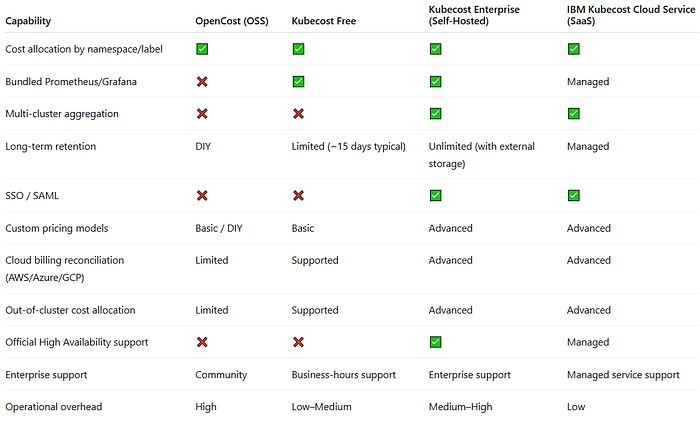
Capability Comparison Matrix
How to Choose: Think in FinOps Maturity Stages
Instead of thinking “Which version is best?” ask:
Stage 1 — Visibility
You need to answer:
- Which namespace is driving cost?
- Are workloads overprovisioned?
- Which team owns what spend?
→ Kubecost Free is often enough.
Stage 2 — Accountability
You need:
- Multi-cluster reporting
- Executive dashboards
- Longer trending windows
- Cost allocation to business units
→ Enterprise or SaaS becomes necessary.
Stage 3 — Governance & Optimization at Scale
You need:
- SSO and access control
- Long-term cost trend analysis
- Formal chargeback
- Integrated cloud billing reconciliation
- HA and operational resiliency
→ Enterprise (self-hosted) or IBM SaaS.
The Strategic Question Most Teams Miss
The real decision is not feature comparison.
It’s this: Do you want to operate your cost visibility platform, or do you want to operate your Kubernetes environment?
Open source maximizes flexibility.
Enterprise maximizes governance and scale.
SaaS maximizes speed and reduces operational burden.
The right choice depends less on Kubernetes size — and more on organizational maturity.
Now what?
Kubernetes cost management is no longer optional.
As AI workloads, autoscaling, and ephemeral clusters expand, cost volatility increases.
Starting with visibility is easy.
Building accountability and economic intent requires structure.
Understanding the progression from OpenCost → Free → Enterprise → SaaS helps you design that structure intentionally.
If you’re looking to bring clarity and accountability to your cloud costs, reach out to 321Gang to start the conversation.

321Gang | 14362 North FLW | Suite 1000 | Scottsdale, AZ 85260 | 877.820.0888